Zakat is one of the five pillars of Islam — a mandatory act of worship that purifies your wealth and supports those in need. Yet for many Muslim women living in Europe, Zakat can feel confusing: Do I even owe Zakat? How do I calculate it on my specific assets? Can I get a tax benefit? This guide answers those questions with a female lens, covering the Islamic foundations and country-specific practicalities across Europe.
Women's Property Ownership in Islam
Before we discuss Zakat obligations, let us establish a foundational truth that many people — Muslims and non-Muslims alike — overlook: Islam granted women full property rights over 1,400 years ago.
A Muslim woman has the absolute right to own, buy, sell, and invest in property and assets independently. Her wealth is entirely her own. She is not obligated to spend it on household expenses — that responsibility falls on her husband, even if she is wealthier than he is.
This means that a Muslim woman's savings, investments, gold jewellery, business income, and other assets are her personal property. And with ownership comes responsibility: if her wealth meets the nisab (minimum threshold) and has been held for one lunar year, she owes Zakat independently of her husband.
Zakat is not a family obligation — it is an individual obligation. If you meet the threshold, you pay your own Zakat, calculated on your own assets. This is your direct connection to Allah through your wealth.
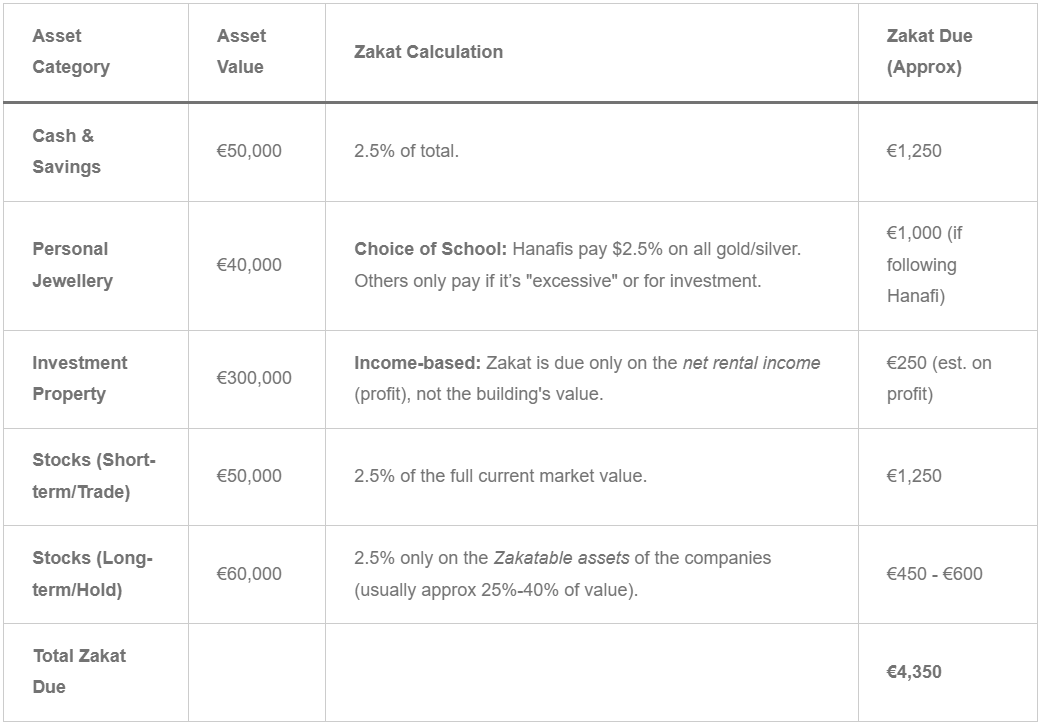
Zakat Obligations for Muslim Women in Europe
The basic Zakat calculation is straightforward: 2.5% of your total Zakatable wealth held for one lunar year, provided it exceeds the nisab. Zakatable assets typically include:
- Cash in bank accounts (current and savings)
- Gold and silver (including jewellery you do not regularly wear, according to the majority scholarly opinion)
- Investment portfolios — stocks, ETFs, mutual funds at market value
- Business inventory and trade goods
- Rental income and receivables
- Cryptocurrency holdings (consult a scholar for specifics)
You may deduct immediate debts and liabilities due within the year. The nisab is typically pegged to the value of 85 grams of gold or 595 grams of silver — most scholars recommend using the silver threshold to ensure more people fulfil this pillar.
Country-Specific Guidance
One of the unique advantages of living in Europe is that several countries offer tax benefits for charitable donations, including Zakat. This means your obligatory worship can also reduce your tax burden — a win-win that every Muslimah should take advantage of.

Switzerland
Switzerland offers generous tax deductions for charitable donations at both federal and cantonal levels. Donations to recognised charitable organisations can typically be deducted from taxable income.
- Tax benefit: Charitable donations are deductible from taxable income (up to 20% of net income at the federal level; cantonal rules vary).
- Recommended organisation: ISRA (Islamic Society of Rahmah) — a Swiss-based organisation that facilitates Zakat collection and distribution in accordance with Shariah principles.
- Protection note: Swiss depositor protection via esisuisse covers up to CHF 100,000 — relevant if you are calculating Zakat on bank deposits held in Swiss institutions.
Ensure the organisation you donate to holds tax-exempt status under Swiss law. Request a donation receipt for your tax filing.
United Kingdom
The UK has one of the most Zakat-friendly tax environments in Europe, thanks to the Gift Aid scheme.
- Tax benefit: Through Gift Aid, registered charities can claim an additional 25% on top of your donation from HMRC at no extra cost to you. If you are a higher-rate taxpayer, you can also claim the difference between higher-rate and basic-rate tax on your self-assessment.
- Recommended organisation: National Zakat Foundation (NZF) — the UK's leading Zakat distribution body, focused on supporting Muslims within the UK.
- Zakat calculator: NZF offers a comprehensive online Zakat calculator that walks you through every asset class, including pensions, ISAs, and crypto. It is the most user-friendly tool available for UK-based sisters.
- ISA consideration: Remember that your Stocks & Shares ISA holdings are Zakatable. The tax-free wrapper does not exempt you from Zakat — calculate Zakat on the market value of your ISA investments on your Zakat anniversary date.
Netherlands
The Netherlands provides tax deductions for donations to organisations with ANBI status (Algemeen Nut Beogende Instelling — Public Benefit Organisation).
- Tax benefit: Donations exceeding a threshold (typically 1% of your aggregate income, minimum €60) to ANBI-registered charities are deductible at your marginal tax rate of approximately 37–49%. For periodic gifts (committed over 5+ years), the threshold is waived entirely.
- Recommended organisation: Islamic Relief Nederland — holds ANBI status and manages Zakat funds with Shariah oversight.
- Pro tip: Consider setting up a periodieke gift (periodic donation commitment) for your annual Zakat. By committing to donate for at least five consecutive years, you can deduct the full amount without any income threshold — maximising your tax benefit.
France
France offers one of the most generous tax credits for charitable giving in Europe.
- Tax benefit: A 66% tax credit on donations to eligible organisations, up to 20% of your taxable income. This means for every €100 you give in Zakat, you receive €66 back as a tax credit. For donations to organisations providing meals, shelter, or care to those in need, the credit rises to 75% (up to a capped amount).
- Recommended organisation: SIF (Secours Islamique France) — one of the largest Muslim charities in France, recognised by the French government as an eligible organisation for tax-deductible donations. They manage dedicated Zakat funds.
- Important note: To claim the tax credit, you must receive a reçu fiscal (fiscal receipt) from the organisation. Keep this document for your tax declaration.
Germany
Germany allows charitable donations to be deducted as Sonderausgaben (special expenses).
- Tax benefit: Donations to recognised charitable organisations are deductible up to 20% of your total income. Germany's progressive tax rates mean that high earners benefit significantly from this deduction.
- Recommended organisations:
- Islamic Relief Deutschland — one of the most established Islamic charities in Germany with full Gemeinnützigkeit (charitable status). They manage dedicated Zakat collection and distribution programmes.
- Muslime helfen e.V. — a German Muslim charity focused on emergency relief and development, also holding charitable status for tax-deductible donations.
- Documentation: For donations under €300, a bank statement or transfer confirmation suffices. For larger amounts, request a formal Zuwendungsbestätigung (donation confirmation) from the charity.
Make Zakat Your Most Rewarding Annual Project
Sisters, Zakat is not just an obligation to check off — it is an annual opportunity to purify your wealth, strengthen your connection to Allah, and make a tangible difference in the lives of those who need it most.
Here is a simple action plan to make Zakat season empowering rather than stressful:
- Set a Zakat anniversary date. Many sisters use 1st Ramadan, but you can choose any date in the lunar calendar. Mark it in your calendar and treat it like an annual financial review.
- Track your assets year-round. Keep a simple spreadsheet of your Zakatable assets so you are not scrambling to add everything up at the last minute.
- Use a Zakat calculator. NZF's calculator (UK) or similar tools help ensure accuracy and give you confidence that your calculation is correct.
- Claim your tax benefits. Do not leave money on the table. Use the country-specific guidance above to ensure your Zakat is also optimised from a tax perspective.
- Donate locally and globally. Consider splitting your Zakat between local organisations (supporting Muslims in your own community) and international causes (water, education, emergency relief).
- Involve your family. Teach your children about Zakat. Let them help you choose where to donate. Make it a family tradition that instils generosity from a young age.
Your Zakat is not a loss — it is a purification. It is the portion of your wealth that was never yours to keep. When you give it with knowledge, intention, and strategic planning, you transform an obligation into one of the most rewarding acts of worship in your entire year.
May Allah accept your Zakat, bless what remains of your wealth, and make you among those who purify themselves through generosity.
Ready to Start Your Halal Investing Journey?
Join our community of muslimahs building wealth with purpose and barakah.
Start Learning