Halal Investing 101
Gold Still a Muslimah's Staple
Our HIF students presented the latest and greatest about gold investing. Their insights were too brilliant to keep to ourselves.

Our Community is investing
Our Her Islamic Finance Students are not shy when it comes to their favorite ethical Investments. Within one of our Program Coaching Calls they presented the Latest and Greatest about Gold Investing, and their insights were too brilliant to keep to ourselves! So here is your complete guide.
Gold has long been one of the most trusted assets for Muslims around the world, and for good reason. In a financial environment filled with complex products, volatile markets, and ever-shifting economic conditions, gold stands out as a rare constant. For Muslim women especially, gold has served as a tool of financial security, personal sovereignty, and intergenerational wealth-building. Today, modern investing frameworks actually reinforce what Muslim households have practiced for generations: gold is stable, resilient, and aligns naturally with Islamic financial values. This guide explores why gold has endured, how it fits into a modern portfolio, and what every Muslimah should understand before investing in it today.
Your Grandmother Got It Right
If you grew up seeing your mother or grandmother buy gold jewelry, store gold coins, or exchange gold during special occasions, you witnessed one of the oldest and most effective wealth strategies in Islamic cultures. What looked like tradition was actually smart financial planning:
- Gold preserved wealth when currencies weakened.
- Gold could be sold quickly in emergencies without relying on banks.
- Gold maintained value more consistently than cash savings.
- Gold was portable wealth, easily passed from one generation to the next. Many women historically lacked access to formal financial systems, yet they still managed to build and protect assets — largely through gold. Modern finance now recognizes gold as a legitimate hedge against economic uncertainty, confirming what previous generations already understood intuitively.
Gold as an Islamic Investment
The Prophet (saw) said: “Gold for gold, silver for silver, wheat for wheat, barley for barley, dates for dates, and salt for salt – like for like, equal for equal, and hand-to-hand; if these goods differ, then you may sell as you wish, provided that the exchange is hand-to-hand.”
From an Islamic finance perspective, gold fits naturally into a halal investment strategy because it is:
- Tangible
- Globally recognized as a store of value
- Permissible to trade when done correctly
- Non-speculative when purchased for long-term ownership The key Islamic considerations include:
Immediate Possession
When purchasing physical gold, ownership must transfer immediately. This means:
- Avoiding contracts where delivery is delayed without justification
- Ensuring that digital or certificate-based gold is backed and redeemable
Avoiding Riba
Gold cannot be traded with gold at unequal amounts or delayed exchanges. For investors, this mainly affects:
- Leveraged gold trading
- Gold derivatives
- Futures contracts These are generally not Sharia-compliant.
Wealth Preservation as a Value

Islam encourages responsible stewardship of money. Gold aligns with the principle of protecting wealth from unjustified risks and inflation.
When to Invest in Gold
Gold is not meant to replace your entire portfolio — but timing your entry and setting expectations helps it work in your favor.
Best Moments to Consider Buying Gold
- Periods of high inflation (gold often rises when money loses purchasing power)
- When stock markets feel overvalued or volatile
- Before long-term saving goals like Hajj, retirement, or children’s education
- As part of building a diversified portfolio
When Gold May Not Be the Right Choice
- If you’re chasing fast returns
- If you need liquidity immediately and don’t want to sell during price dips
- If you’re replacing all other asset classes with gold (over-concentration can stunt growth) A simple discipline many investors use: Buy small amounts consistently over time rather than trying to time the exact bottom.
Different Ways to Invest in Gold
Ethical Considerations
Muslim investors are increasingly mindful not just of financial returns, but how and where their money circulates. About 435 tonnes of gold, worth USD 31 billion have been illegally exported from Africa in 2022.
Ethical Sourcing
Gold mining can sometimes involve:
- Exploitative labor practices
- Environmental harm
- Community displacement Choosing gold suppliers who follow responsible mining practices helps align your investment with Islamic ethics of justice and stewardship.
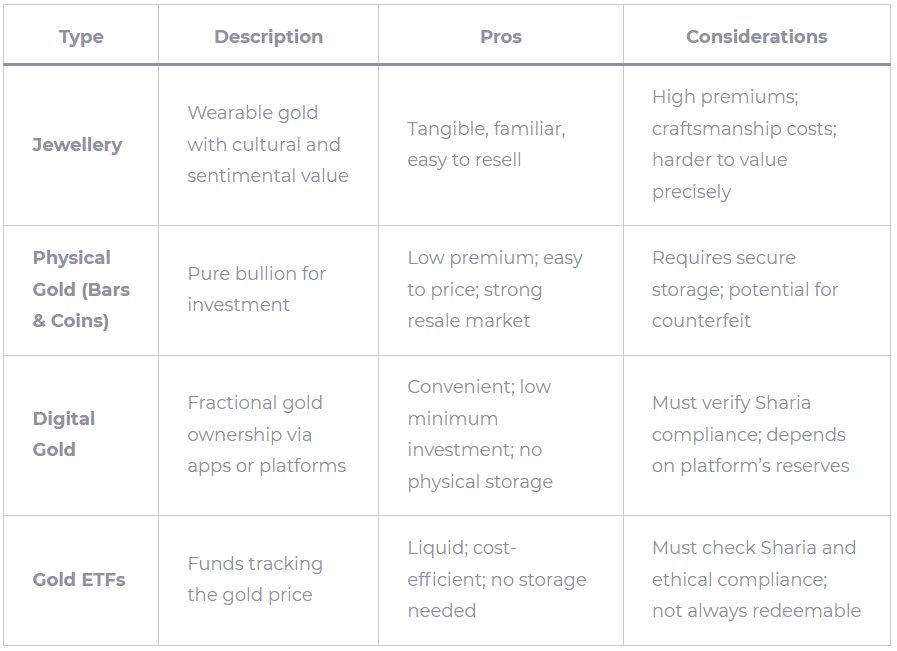
Transparency
Ensure your gold, physical or digital, comes from providers who offer:
- Clear pricing
- Verified purity
- Ethical origins
- Secure storage and documentation Long-term, intentional investing aligns best with Islamic principles and financial stability.
Take Action
✅ Don’t go gold shopping in the illegal importing countries (e.g. UAE) ✅ Ask Where did my gold come from? Always ✅ Choose gold from transparent supply chains (ethically certified) in whatever form – e.g. Raiffeisen Responsibility ETF (ticker RGRT) ✅ Share and educate! Your voice matters
Tax & Storage Considerations
Gold investing isn’t just about buying the asset — it’s about managing it responsibly.
Taxes
Depending on your country:
- Physical gold may be subject to capital gains tax when sold
- Gold jewelry sold at a loss or for personal use may have different tax implications
- Gold ETFs or gold funds may be taxed like other investment securities Always check local tax regulations or consult a professional, especially if you plan to buy or sell substantial amounts.

Storage
Physical gold requires careful planning:
- Home safes (cost-effective but vulnerable)
- Bank safe deposit boxes (secure but limited access times)
- Insured professional vaults (highest protection, annual fees apply) Digital or ETF gold removes storage concerns but comes with other risks such as counterparty reliability.