As Muslim women seeking financial independence, understanding the concept of riba is essential. Riba sits at the heart of Islamic finance, and grasping its meaning empowers you to make investment decisions that align with both your financial goals and your faith.

What Is Riba?
Riba, in its simplest definition, refers to guaranteed interest or profit on loaned money regardless of the outcome. When someone lends money and demands a fixed return irrespective of whether the borrower's venture succeeds or fails, that fixed return is riba.
Riba is forbidden in Islam because it ensures profit for the lender without any value creation. In a just economic system, returns should be tied to genuine risk, effort, and the creation of real value. Riba disconnects money from productive activity, creating a system where wealth grows for some while others bear all the risk.
Why Avoid Riba?
Beyond the clear religious prohibition, riba causes tangible harm to individuals and societies:
- Economic disparity: Interest-based systems cause wealth to accumulate disproportionately among those who already have it. The rich lend and grow richer through guaranteed returns, while borrowers -- often those with fewer resources -- pay more than they received. Over time, this widens the gap between the wealthy and the struggling.
- Debt traps: Riba creates never-ending cycles of debt. When borrowers cannot repay the principal plus interest, they borrow again to cover the shortfall, sinking deeper with each cycle. This is particularly devastating for vulnerable individuals and families who turn to loans in times of need.
- Economic instability: History has shown repeatedly that interest-based financial systems are prone to bubbles and crashes. When money is created through debt rather than productive enterprise, the entire economy becomes fragile. The 2008 financial crisis is one stark example of what happens when riba-driven speculation spirals out of control.

Quranic Guidance on Riba
The Quran addresses riba directly and unequivocally in multiple verses, leaving no doubt about its prohibition:
Surah Al-Baqarah (2:278-279): "O you who have believed, fear Allah and give up what remains [due to you] of interest, if you should be believers. And if you do not, then be informed of a war against [you] from Allah and His Messenger. But if you repent, you may have your principal -- [thus] you do no wrong, nor are you wronged."
This verse calls believers to abandon any outstanding interest and warns of severe consequences for those who persist in dealing with riba.
Surah Aal-Imran (3:130): "O you who have believed, do not consume interest, doubled and multiplied, but fear Allah that you may be successful."
Here, Allah specifically addresses the practice of compounding interest, which magnifies the harm of riba exponentially.
Surah Al-Baqarah (2:245): "Who is it that would loan Allah a goodly loan so He may multiply it for him many times over? And it is Allah who withholds and grants abundance, and to Him you will be returned."
This verse highlights the beautiful alternative: lending and giving for the sake of Allah, with the promise of multiplication in ways that transcend material returns.
Surah Al-Baqarah (2:275): "Those who consume interest cannot stand [on the Day of Resurrection] except as one stands who is being beaten by Satan into insanity. That is because they say, 'Trade is [just] like interest.' But Allah has permitted trade and has forbidden interest."
This powerful verse draws a clear line: trade and business are permissible; interest is not. The two are fundamentally different, even if some claim they are equivalent.
Empowering Women Through Halal Investing
Understanding riba is not just about knowing what to avoid -- it is about discovering what is possible. Halal investing opens up a world of ethical, profitable opportunities:
- Invest in businesses consistent with Islamic principles: You can own shares in companies that produce real goods and services, contribute positively to society, and operate ethically. Halal investing means your money supports genuine economic activity.
- Avoid harmful industries: Halal screening filters out companies involved in alcohol, gambling, pork production, and riba-based financing. Your portfolio reflects your values.
- Participate in profit-and-loss sharing: Unlike riba, where returns are guaranteed regardless of outcomes, Islamic finance encourages structures where investors share both the rewards and the risks. This is fairer, more sustainable, and more aligned with real economic activity.
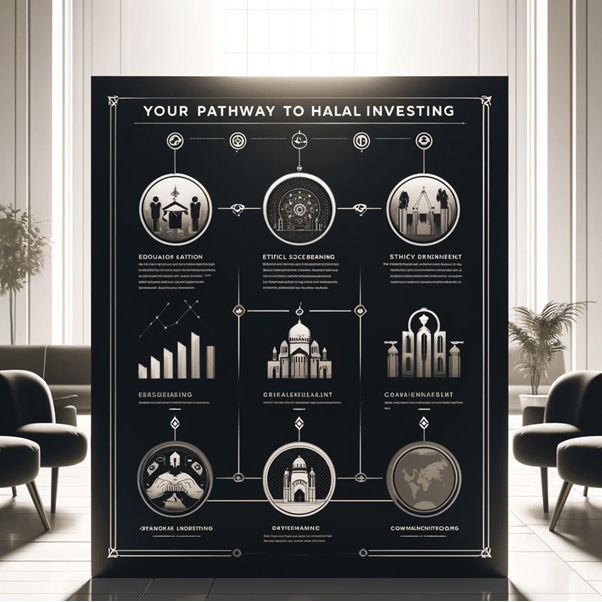
How to Start Your Halal Investing Journey
- Education through the HIF program: Knowledge is your most powerful tool. Our courses break down Islamic finance principles into clear, actionable lessons designed specifically for Muslim women. You will learn how to screen investments, understand financial statements, and build a halal portfolio with confidence.
- Seek halal opportunities in stocks, real estate, and businesses: Once you understand the principles, you can explore a variety of halal investment avenues. Sharia-compliant stocks, halal real estate investment trusts (REITs), and ethical business ventures all offer paths to grow your wealth without compromising your faith.
- Join communities focused on Islamic finance: Surround yourself with like-minded sisters who share your commitment to halal wealth-building. Community provides support, accountability, and shared knowledge. At Her Islamic Finance, our community of over 700 muslimahs across 7+ countries is here to walk this journey with you.

Understanding riba is the foundation upon which all halal investing is built. With this knowledge, you are equipped to make financial decisions that honour your faith, protect your wealth, and contribute to a more just economic system.
Ready to Start Your Halal Investing Journey?
Join our community of muslimahs building wealth with purpose and barakah.
Start Learning